[meteorite-list] Meteorite Supposedly Lands in Peru, Citizens Report Radiation Sickness
Ron Baalke
baalke at zagami.jpl.nasa.gov
Mon Sep 17 20:35:38 EDT 2007
http://www.livinginperu.com/news/4719
Meteorite Lands in Puno, Peru Near Bolivia, Citizens Report
Radiation Sickness
Living in Peru
September 17, 2007
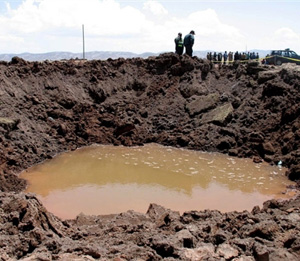
Local police reported that the supposed meteorite made a hole 6 meters
(19 feet) deep and 30 meters (98 feet) wide.
© Andina
(LIP-ir) -- Peru's Andina News Agency reported today that Puno's
Regional Health Directorate sent a group of specialists to the Carancas
community in the province of Chucuito near Bolivia to take samples of a
meteorite that supposedly landed in the area.
Jorge Lopez Tejada, a representative for the institution, stated that an
environmental cleaning crew was going to the area to take earth and
water samples from the actual landing site and from surrounding areas.
"The samples will be tested in Lima, where the necessary equipment is
available. We hope that results will be ready within 7days," said Jorge
Lopez Tejada.
In addition, Tejada stated that a health brigade, consisting of doctors
and nurses would be sent to the landing site to aid people that had
reported health problems after having gotten close to the supposed
meteorite.
"Between 10 and 12 people have reported dizziness, migraines and in some
cases vomiting. They assure that after having had close contact with the
object the symptoms began," stated Tejada.
Furthermore, Tejada stated that check ups would be performed and that it
had not been discarded that the symptoms could be related to the glowing
object which fell from the sky. "They are healthy people, it could be
(due to) radiation, we don't know, we are assuming, it's worth
investigating. Things will be clearer tomorrow," stated Tejada.
[meteorite-list] Scientist Confirms Meteorite in Puno, Peru is a Chondrite
Ron Baalke
baalke at zagami.jpl.nasa.gov
Tue Sep 18 21:20:21 EDT 2007
This just came out. I'm still highly skeptical that this is a
meteorite.
Ron B.
--------------------------------------------------
http://www.livinginperu.com/news-4730-environmentnature-scientist-confirms-meteorite-puno-peru-is-chondrite
Scientist Confirms Meteorite in Puno, Peru is a Chondrite
Living in Peru
September 18, 2007
(LIP-ir) -- Peru's official government news agency reported this
afternoon that scientists which went to the town of Carancas in the
Region of Puno, Peru, have confirmed that the glowing object which fell
from the sky on Saturday afternoon was indeed a meteorite.
Volcanologist for Peru's Geological, Mining and Metallurgical Institute
(INGEMMET), Luisa Macedo, confirmed that a chondrite meteorite had
caused the 17 meter (55 foot) wide and 5 meter (16 foot) deep crater
when it landed on earth.
It was reported that with the help of the Desaguadero Municipality, the
water would be drained out of the crater to establish the exact size of
the hole that was made by the chondrite meteorite.
Macedo explained that the chondrite was not radioactive and did not have
any toxic gases or substances which could be harmful to peoples health.
On the other hand, Macedo stated that it had not yet been established if
the water supply in the province of Chucuito had been contaminated or not.
Aside from the analysis Macedo is performing, the National University of
Altiplano, Peru's Nuclear Energy Institute, the National Institute of
Natural Resources, the Ministry of Health and a Bolivian university are
all taking part in the analysis of the area.
[meteorite-list] Experts Now Say a Rare Meteorte Likely Caused Peru Crater
Ron Baalke
baalke at zagami.jpl.nasa.gov
Thu Sep 20 20:33:16 EDT 2007
http://www.signonsandiego.com/news/world/20070920-1507-peru-meteorite.html
Experts now say a rare meteorite likely caused Peru crater
By Edison Lopez
ASSOCIATED PRESS
September 20, 2007
LIMA, Peru - Peruvian astronomers said Thursday that evidence shows a
meteorite crashed near Lake Titicaca over the weekend, leaving an
elliptical crater and magnetic rock fragments in an impact powerful
enough to register on seismic charts.
As other astronomers learned more details, they too said it appears
likely that a legitimate meteorite hit Earth on Saturday - an rare
occurence.
The Earth is constantly bombarded with objects from outer space, but
most burn up in the atmosphere and never reach the planet's surface.
Only one in a thousand rocks that that people claim are meteorites turn
out to be real, according to Jay Melosh, an expert on impact craters and
professor of planetary science at the University of Arizona.
Melosh was skeptical at first, initially calling it a "non-meteorite"
and suggesting that the crater might have possibly come from below as a
volcanic eruption. Then scientists learned of more details about the
crater, as well as witness descriptions of a thunderous roar and a rain
of smaller rocks coming down.
"It begins to sound more likely to me that this object could indeed be a
meteorite,' Melosh said Thursday.
Such impacts are rare, and astronomists still want to do other tests to
confirm the strike.
Other details don't add up, they said - such as witness accounts of
water in the muddy crater boiling for 10 minutes from the heat.
Meteorites are actually cold when they hit Earth, astronomists say,
since their outer layers burn up and fall away before impact.
Experts also puzzled over claims that 200 local residents were sickened
by fumes from the crater. Doctors who examined them found no evidence of
illness related to the meteorite, and one suggested a psychosomatic
reaction to the sight and sound of the plunging meteor.
More details emerged when astrophysicist Jose Ishitsuka of Peru's
Geophysics Institute reached the site about 6 miles from Lake Titicaca.
He confirmed that a meteorite caused a crater 42 feet wide and 15 feet
deep, the institute's president, Ronald Woodman, told The Associated
Press on Thursday.
Ishitsuka recovered a 3-inch magnetic fragment and said it contained
iron, a mineral found in all rocks from space. The impact also
registered a magnitude-1.5 tremor on the institute's seismic equipment -
that's as much as an explosion of 4.9 tons of dynamite, Woodman said.
Local residents described a fiery ball falling from the sky and smashing
into the desolate Andean plain.
Doctors told an Associated Press Television News cameraman at the site
that they had found no sign of radioactive contamination among families
living nearby. But they said they had taken samples of blood, urine and
hair to analyze.
Peasants living near the crater said they had smelled a sulfurous odor
for at least an hour after the meteorite struck and that it had provoked
upset stomachs and headaches. But Ishitsuka said he doubts reports of a
sulfurous smell.
Meteor expert Ursula Marvin said that if people were sickened, "it
wouldn't be the meteorite itself, but the dust it raises."
A meteorite "wouldn't get much gas out of the earth" said Marvin, who
has studied the objects since 1961 at the Smithsonian Astrophysical
Observatory in Massachusetts. "It's a very superficial thing."
Peter Schultz, a meteor crater specialist at Brown University who is
eager to visit the Peruvian site, said the latest details suggest this
might be an unusual type of meteor strike, and that given the crater's
size, the original meteoroid had to have been at least 10 feet in
diameter before breaking up.
"With everything I see reported now, it seems to me like we just got
hit," Schultz said.
Justina Limache, 74, told the Lima daily El Comercio that when she heard
the thunderous roar from the sky, she abandoned her flock of alpacas and
ran home with her 8-year-old granddaughter. She said that after the
meteorite struck, small rocks rained down on the roof of her house for
several minutes and she feared the house was going to collapse.
Modesto Montoya, a member of the medical team, told El Comercio that
fear may have provoked psychosomatic ailments.
"When a meteorite falls, it produces horrid sounds when it makes contact
with the atmosphere," he said. "It is as if a giant rock is being
sanded. Those sounds could have frightened them."
Associated Press writers Seth Borenstein in Washington and Monte Hayes
in Lima contributed to this report.
More information about the Meteorite-list
mailing list